– Enver Hoxha –
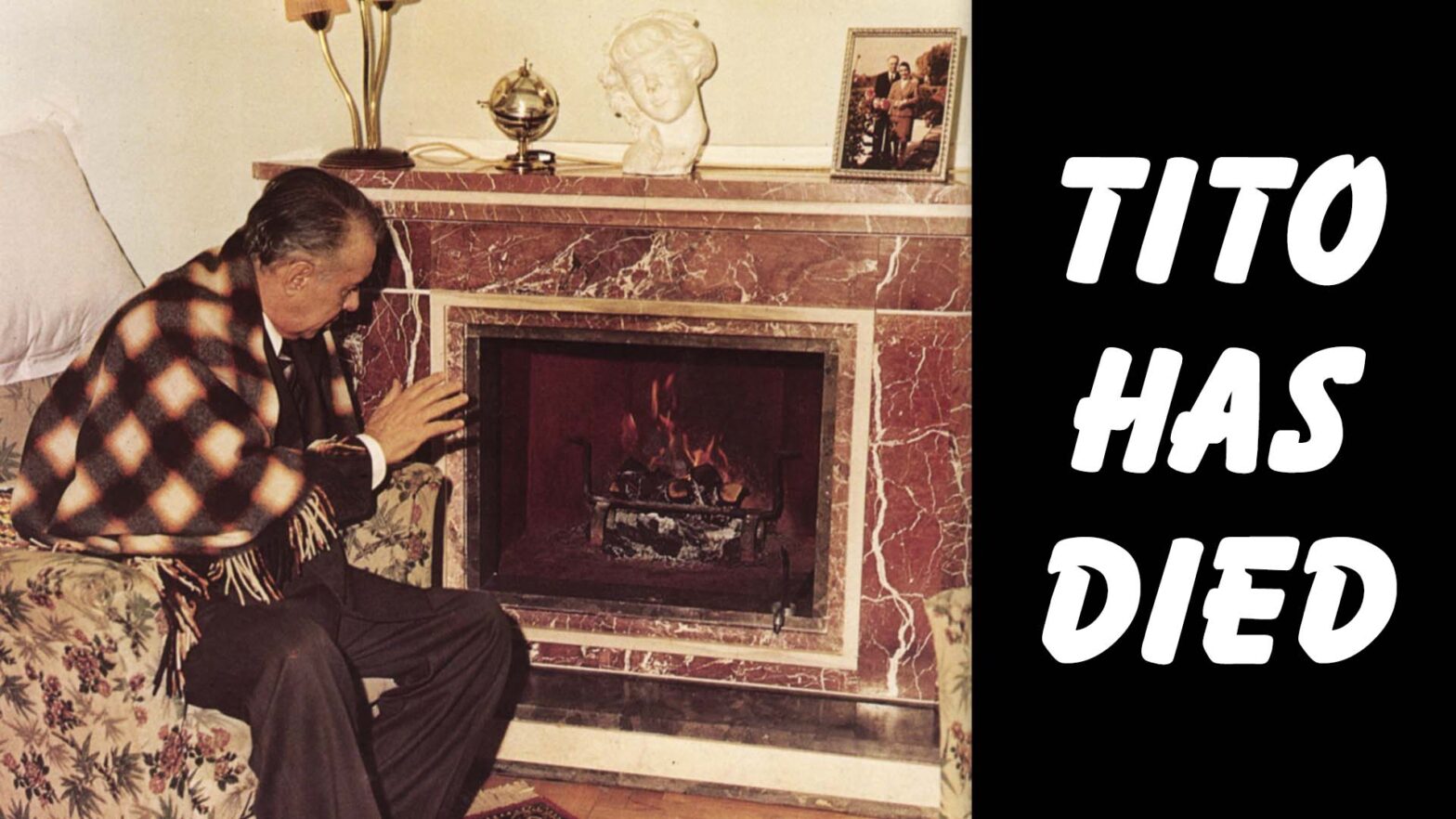
TITO HAS DIED — May 4, 1980
Today, the Yugoslav news agency Tanjug announced Tito’s death. Tito was one of the most dangerous enemies of communism. His death will leave the peoples of Yugoslavia in economic and political misery, division and conflicts among the mosaic of peoples that form what is called the Federation of Yugoslavia.
THE TITO MONARCHY COMES TO AN END — May 10, 1980
The inevitable disappearance, orchestrated with such mastery and splendour, of the monarch Tito has concluded. Ironically, with the anthem of the Internationale. While Tito’s grave stone was laid, the Titoites did not hesitate to lie and engage in demagogy. This bourgeoisie is low, cunning and shameless.
We, the Albanian communists, fought Tito mercilessly while he was alive, and we will continue our fight against Titoism, one of the variants of modern revisionism, until its end.
As the apostles left behind by Tito said in their masses, when they sang the De profundis to their “leader,” the orientation of Yugoslav politics is: 1) “brotherhood and unity,” 2) “self-administration,” 3) “non-alignment.” So, “father, son and the holy spirit.” Amen!
Brotherhood and unity is the product of Clemenceau in the Treaty of Versailles; thus, a state with plundered treasures above and below, sewn together with imperialist machinery, on which they placed a monarchy and a king who oppressed different peoples and followed the policy of the French master. Paris put this puppet king on the throne and Marseille killed him before he had time to sing the Marseillaise.
This formula “brotherhood and unity” from the monarchy transformed into a federative republic after World War II. It was also called socialist, to deceive the masses and peoples who fought for their liberation and unity to the point of secession. But who allowed the peoples of Yugoslavia to self-determine their fate even to the point of secession? Instead of self-determination, they were given self-administration.
Self-administration was a pseudo-Marxist mask hiding the capitalist system that was being built, to transform the Karadjordjević monarchy into a new form. The form changed, the master changed. Karadjordjević had a main master and did not hide it, France. The Titoites had another main master: the USA, but also several other capitalist countries, and liked to present himself as “equal among equals.” Tito presented himself as “uninvolved” because that’s what he liked, and he liked it that way for his masters.
“Non-alignment” is the opposite of alignment. Tito wanted to deceive the people with a small “non” and to present himself as “independent” when the noose was around his neck and when he put the noose around the necks of the peoples of Yugoslavia. But Tito lived as a king with the proverb “after me, the flood.”
Today, world capitalism asks the question: “What will happen after Tito?” We, the Albanian communists, say that we predicted what will happen “after Tito” long before “after Tito.” We are dialecticians. “The sun appears when it rises,” our people say, and we saw and fought against Titoism from its birth until it ended in betrayal, dishonesty, intrigues, murder, genocide and lies — all in the service of world capitalism with the Americans at the forefront. It ended in dirty political acrobatics that provided means for the pleasures and amusements of King Tito and his courtesans, while bringing division, eclecticism and political and economic misery to the peoples of Yugoslavia.
“The funeral pomp” of the king has its tail back, like a scorpion. Kings and presidents of the bourgeoisie and revisionism pay for this style of luxury funeral. “Tito’s life was closed beautifully” in the grave, and world capitalism “sowed the wind, and shall reap the storm.” Now it asks the question: “What will it be like after Tito?” Everything will be destroyed because it was already destroyed; everything will go bankrupt because it was already bankrupt; everything will be unmasked because it was a bluff, the castle was built on sand.
THE LEGACY OF TITO — May 23, 1980
Tito did not have faith in the unity of the various nations that make up Yugoslavia, and this stemmed from his anti-Marxist beliefs. He and his group were nationalist-chauvinists. The slogan “brotherhood and unity” was based on an ideology that divides rather than unites. It “unites” only for the stronger clan to dominate and exploit the weaker.
A correct analysis of the situation within Yugoslavia does not allow one to think that Tito, with his “authority,” had achieved “brotherhood and unity” in the Federation. It is true to say that the Federation was preserved, and the Titoite bourgeois layer of federalists was created, but not a unity of the republics and autonomous regions, as well as the various nations that make up the Federation.
Tito was a clever bourgeois politician and statesman who knew how to hide, to manoeuvre under pseudo-Marxist slogans, to maintain centralized power in the Federation for a prolonged period, but at the same time, to make a turn towards decentralization within it because nationalist and chauvinistic feelings for dominance and hegemony emerged. In the race for dominance, the Serbs, Croats and Slovenes were put against each other. Tito, in fact, could not measure and restrain these ambitions. He leaned towards the Croatian-Slovenian clan, but acted in a way that he played the role of a “paid and fair” arbitrator, giving the impression of a “wise, clever” and “experienced” “Marxist” leader. Thus, in this spirit, he struck the Serbian nationalism of Ranković, then that of Nikezić and Koča Popović. Later, in 1976-77, he targeted the group of Serbian military officials led by Jovanović, Šumonja and others, just as he had targeted the Croatian nationalist group in 1971, led by Tripalo. Why mention these purges? These speak to the rivalries that exist and cannot help but exist in a capitalist state.
Unequal economic development in the republics and autonomous regions within the Socialist Federal Republic of Yugoslavia fuelled chauvinism, nationalism and hegemonism among the Serbian and Croat-Slovenian clans for Montenegro, Macedonia, Bosnia and Herzegovina (the autonomous region of Kosova always remained an oppressed and exploited region), or else they would be suppressed. This way, the republics, autonomous regions and Federation were preserved, but economic decentralization was established, and the pseudo-socialist system of self-administration was implemented.
It was thought that with these actions, a solution was found to Yugoslav clan wars for hegemony, and at the same time, the path to faster development in the unequal form of capitalism in the republics, as well as the enrichment of various layers of the new bourgeoisie and individuals in particular, was opened. Tito and his Croat-Slovenian clan, the mastermind behind this manoeuvre, favoured not only the unequal development of the republics and regions but also strengthened Croatia and Slovenia with foreign investments. They de facto, if not de jure, established the hegemony of this clan. Thus, rivalries between nations and nationalities, between republics and regions in the SFR of Yugoslavia, not only did not disappear but intensified and will continue to intensify.
It is clear that Tito’s clan held the army and state security in its hands, constituting the only pillar of the maintenance of the Titoite federalist clan in this devised formation. The League of Communists of Yugoslavia had no leadership function, neither UDB-directed nor educational, as it had nothing to educate, no society to preach and no ideals to inspire the individual.
Self-administration was, in fact, nothing more than a parody of administration; the workers did not have a “voice in the chapter” — they were there for show. In collaboration with multinational companies and foreign financial capital that had divided zones of influence and exploitation in federal Yugoslavia, the new bourgeoisie took control. And this grand manipulation was carried out by Tito’s clan and legitimized by some forums at the regional, republican and federal levels, which mimicked Mussolini’s corporative chambers.
This capitalist chaos, this anarchistic regime, this Mussolini-type “corporative” form could work as long as Tito was alive, but what would happen after him? The leaders of the Titoite clans would devour each other like dogs and wolves. It is said that Tito allegedly foresaw how things should be directed after his death and created a “collective leadership.” But what was and what did this collective leadership solve? After Tito, there would no longer be a single president but many presidents in one presidency. This presidency is composed of one elected representative for each republic and autonomous region for five years, and each of these, through rotation, would be the “chairman” of this presidency for one year.
Everything was “arranged,” but nothing was resolved, and nothing will be resolved! What will happen? Tito’s Croatian-Slovene clan will rule, albeit not very visibly, and, in fact, this will be the Bakarić-Dolanc group. The others are federalists, but puppets, until the cohesion of the Serb-Montenegrin-Macedonian rival group occurs, and then, just like the first federalist, if they becomes hegemonic, or separatist, the conflicts deepen. So, after Tito, there can be no stability except temporary. The current situation avoids the dominance of the Serb clan. But until when? Currently, there is a collegial power system of two presidencies, that of the republic and that of the LCY. All 31 of them are ineffective in making decisions; all will take turns at the top through rotations, and this rotation is such that over time, individuals with or without authority from every clan will come there, creating instability, rivalry and leading to the necessary creation of a single personality that will replace this “castle” (power structure) built on sand.
The Croatian-Slovene clan now dominates, but in the times to come, the Serbian clan will also differentiate and assert itself (Minić, Ljubić, Vidić, Marković, Stambolić and others). Currently, they work to create favourable situations for their clan, try to strike in the economic field and gain dominant political positions. The Serbian clan is more alive, more dynamic and has broader positions taken as a whole. The current leadership wants to be federalist because it serves its interests, but this will not depend very much on its will. Capitalist development in new forms and the influence of foreign financial capital will play decisive roles in the future.
For now, the issue of Soviet intervention in Yugoslavia does not arise. The question lies in the form capitalist power will take in this country. I think the tendency to preserve the Federation will continue, but at the same time, there will be a struggle for hegemony between Serbs on the one hand, and Croats and Slovenes on the other. This rivalry will take the form of the centralization of power, in which the economically stronger clan will dominate and have the support of the military.
In these situations, the Albanians living in Yugoslavia must strengthen their national unity and affirm it through constitutional rights. They must try to preserve, strengthen and expand the rights they have gained. They must be vigilant against the Great-Serbs, but also in alliances with other nationalities; they need to be mature, neither blindly liberal nor sectarian and distrustful in the face of any favourable situational alignment in their favour. They must know how to benefit in every situation, be patient and prepare for their better and freer future. Therefore, the Albanians in Yugoslavia should not engage in adventures, nor should they allow their rights to be suppressed or trampled on. Their self-determination will be brought about by objective and subjective circumstances.
(From “Kosova is Albania”)