– On the 87th anniversary –
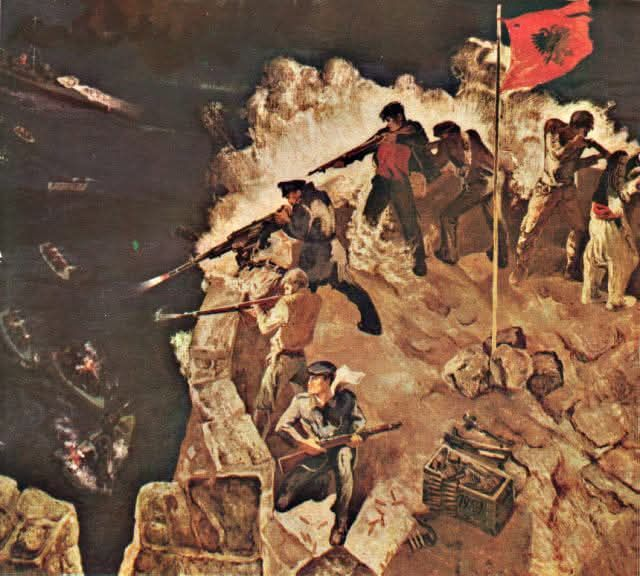
April 1939 – The Italian aggressors were met with armed resistance by the Albanian people. Thousands of Albanian patriots fought with bravery in Durrës, Vlora, Saranda and Shëngjin, as well as in the interior of the country, against the Italian invaders. The most resolute resistance to the fascist occupiers was mounted in Durrës against the second column of the expeditionary forces. This resistance was organised by volunteer patriots arriving from various parts of the country, alongside the soldiers and sailors of Durrës, among whom Mujo Ulqinaku distinguished himself. They confronted the Italian aggressors with volleys of artillery, rifle and machine-gun fire, repelling them into the sea on three occasions and inflicting fatalities and material losses upon the enemy. Only the overwhelming superiority in numbers and armaments overcame the resistance of the Albanian patriots, enabling the enemy to occupy Durrës. The forces that continued their advance towards Tirana encountered further resistance at the bridge of Shijak, which had been blown up by volunteers, as well as near Vora.
Against the forces of the first column of the expeditionary troops, which landed in Shëngjin, a group of patriotic soldiers and a number of civilians who had seized weapons from the depots of Lezha fought with notable courage. They held the aggressors at bay for several hours. Albanian patriots also resisted these forces at the entrance to Lezha, in Bushat and Barbullush, on the heights of the Beltoja hills and particularly at the Bahçallëk Bridge, where groups of soldiers from the “Drini” battalion, together with several patriotic officers who had not abandoned their units, in cooperation with workers from Shkodra and peasants from Postriba, repelled the attacks of the Italian army, holding it in check for hours.
Fierce resistance was also mounted by the patriotic workers and peasants of Vlora, who fought against the forces of the third column of the Italian army. In the fighting for control of the harbour, the aggressors suffered both dead and wounded. An even bloodier engagement took place on the olive-covered heights of Bestrova, where the patriots of Vlora, together with volunteer soldiers arriving from Elbasan, immobilised the Italian forces for two days and one night.
The landing forces of the fourth column encountered strong resistance in Saranda. For many hours, groups of patriots, both military and civilian, though poorly armed, fought bravely against Italian forces supported by tanks, aviation and naval artillery, inflicting upon them both fatalities and injuries.
The resistance of the Albanian people against fascist aggression, although uncoordinated due to the absence of unified national leadership, demonstrated to the world that the Albanian people did not accept foreign occupation and were determined to continue the struggle against it to the end. This armed resistance constituted the prelude to the National Liberation War, which they waged against the Italian and German occupiers and their collaborators under the leadership of the Communist Party of Albania.